
Chester City Directory Collections
Chester's historical record shelf has two complementary routes. The Delaware County Historical Society, or DCHS, in Chester publishes the clearest physical run: city volumes from 1879 through 1931, plus 1941, 1956, and 1959. The historian-managed Delaware County History collection supplies many earlier digitized books. Neither route is a complete annual sequence. A listed name identifies a person in that edition and within its stated geographic scope, not a permanent home or a full household. Later telephone books, newspapers, estate records, and maps can bridge selected gaps.
| Collection | Years | Where Held | Access |
|---|---|---|---|
| Chester City directories | 1879-1931; 1941, 1956, 1959 | Delaware County Historical Society, Chester | Ask staff about the relevant volume, sections, and copying rules |
| Digitized Chester directory volumes | 1859-60; selected volumes through 1906-07 | Delaware County History municipal collection | Online reading |
| Telephone books | 1957, 1958, 1965, 1970-present | DCHS | Listed-name and address clues where a person chose to be listed |
| Chester and Delaware County newspapers | 1876-1994 across named runs | Delaware County Libraries and DCHS | Library archive requires a cardholder login; DCHS has on-site runs |
| Chester maps and atlases | Maps from 1870; DCHS atlases 1872-1967 | DCHS and county-recognized digital collections | Address and building continuity, not household proof |
Start with the exact edition that fits the question. The published lists do not verify a reverse section for every book, and they do not establish a gap as a year with no Chester residents. Ask DCHS whether the desired copy has an alphabetical portion, a street portion, or both.
Chester Historical Shelves at DCHS
DCHS research resources extend well beyond the directory run. The society reports more than 8,000 deeds and related property, estate, and legal documents, with early material from 1681. Its holdings also include Chester Rural Cemetery records, E. F. White funeral records, church records, family Bibles, school documents, yearbooks, newspapers, maps, and oral histories. These are date-bound research sources, not a current household list. Bring the surname, address spelling, approximate era, and the directory edition already checked so staff can point to a more precise collection.
The nearest public-library entry point is J. Lewis Crozer Library, at 620 Engle Street in Chester. Its role is access to the county library system and its authenticated resources rather than the fullest stated city-directory shelf. Published hours are Tuesday through Thursday, 9:00 a.m. to 8:00 p.m., and Friday and Saturday, 9:00 a.m. to 4:00 p.m. It is closed Sunday and Monday.
Use the library as a staffed starting point for catalog and newspaper access, then use DCHS for the directory years it specifically lists.
Chester Directory Scope Changes
Titles matter in Chester. The 1859-60 borough book describes alphabetically arranged inhabitants along with occupations, places of business, dwellings, streets, institutions, schools, churches, travel schedules, and civic groups. The 1889-90 title advertises a general citizens section, partnership material, a street directory, and coverage for South Chester, Upland, and Eddystone. The 1891-92 edition adds Media. An absence from one edition can therefore reflect title scope rather than a move.
That changing scope has deep local roots. Chester began as Upland, was renamed by William Penn in 1682, incorporated as a borough in 1701, and became a city in 1866. South Chester and North Chester developed separately in the nineteenth century. Preserve the place name printed in the volume, especially when a surname or address falls near an older municipal boundary.
Address continuity needs the same care. DCHS reports atlases from 1872 through 1967, while the county-recognized historical collection lists Chester Sanborn plates and maps from 1870 and 1875. Those sources can show a block, building, or older street layout. They do not prove who occupied a building. No official Chester-wide street-renumbering year was located in the reviewed materials, so compare the printed number with the edition's map, legal parcel description, and Recorder plan or deed instead of assuming a modern number has always applied. County Planning's historic-research desk directs researchers to DCHS, County Archives, PA-SHARE, the county-history collection, and the Mapping Hub when the paper trail needs another route.
Reading Chester City Directory Entries
A Chester entry should be transcribed as the edition prints it. The actual verified fields vary by title. The safest common inventory comes from the title-page and collection inspection, not assumptions about later publisher conventions. Record the spelling, the full address or place of dwelling, the stated business or occupation field, and the edition's geographic language. Do not add spouse names, widow marks, owner marks, or abbreviation meanings unless the open volume and its key actually show them.
| Alphabetical name | The early borough title says inhabitants are arranged alphabetically. Preserve initials, punctuation, and variants. |
|---|---|
| Dwelling or address | Early Chester titles state a place of dwelling or street context. It is evidence for that edition year only. |
| Business or occupation | Where stated in that edition, this can distinguish two same-name people and suggest a newspaper or partnership lead. |
| Street component | The 1889-90 title explicitly advertises a street directory. Verify that section in the volume before relying on it. |
| Edition scope | Record whether the title includes Chester alone or other named places, such as South Chester, Upland, Eddystone, or Media. |
- Criss-cross directory
- A street-ordered section that may list an address before a name. Chester's 1889-90 title confirms a street directory, but each edition still needs inspection.
- Householder index
- An alphabetical arrangement of people or households. A title page must confirm whether a particular Chester book uses one.
- Abbreviation key
- The publisher's explanation of shortened terms, usually near the front of a volume. Photograph or copy it with the entry.
Chester City Directory Volumes Online
Delaware County History's Chester collection lists digitized directories for 1859-60, 1869-70, 1872-73, 1876-77, 1879-80, 1880-81, 1882-83, 1883-84, 1885-86, 1887-88, the 1889 business directory, 1889-90, 1891-92, 1893-94, 1895-96, 1898-99, 1904-05, and 1906-07. County Planning names that historian-managed collection among its historical research routes. Early titles may describe borough, city, county, or business coverage, so the title page is part of the evidence.
Use the digitized Chester directory collection to compare nearby editions at home. For a gap after 1906-07, move to DCHS rather than guessing that publication continued every year.
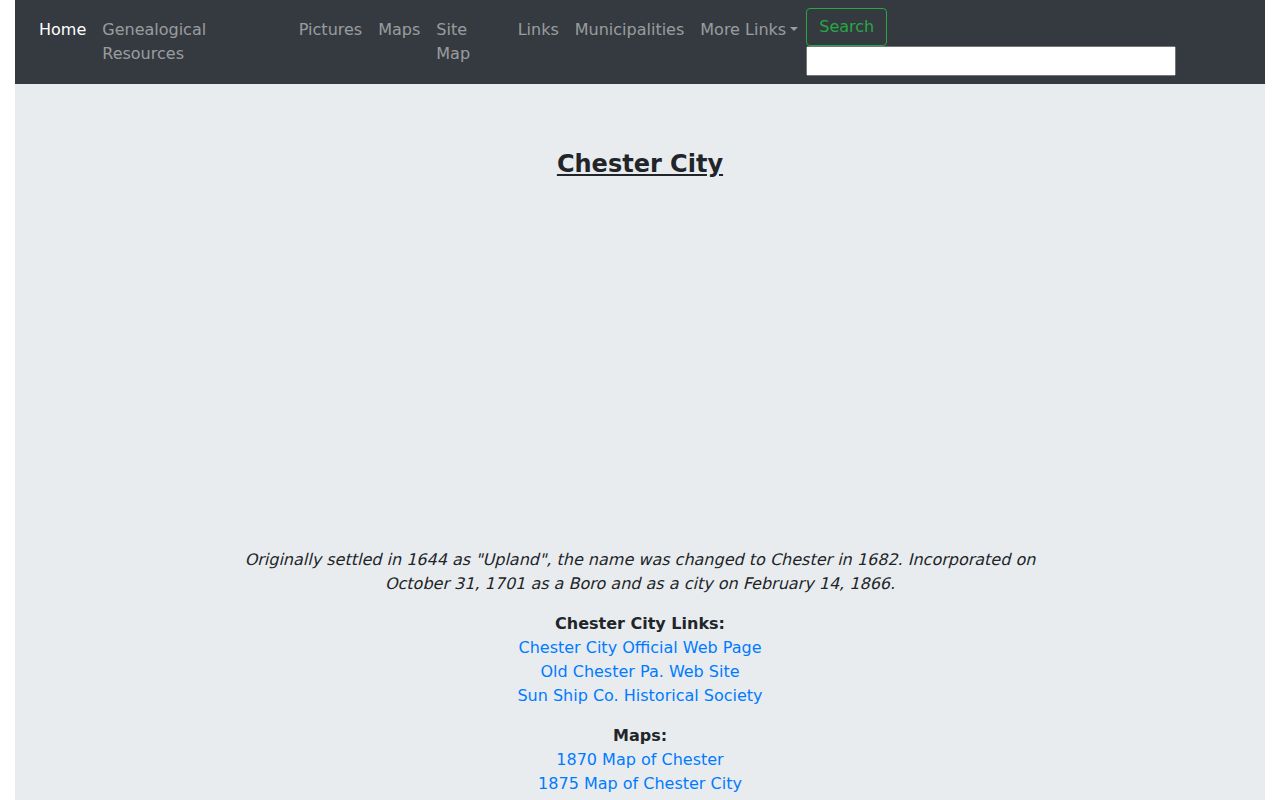
The online collection shows the early sequence, while the DCHS shelf supplies the separately stated later Chester volumes.
Chester Newspaper Gaps
When directory years jump, a dated notice can narrow the interval. Delaware County Libraries' historical newspaper access identifies Chester Daily Times for 1876-81, Chester Evening Times for 1886, Chester Reporter for 1941, Chester Times for 1882-1959, and Delaware County Daily Times for 1959-94. The electronic archive is reserved for card-holding Delaware County residents. DCHS also reports microfilm and local newspaper runs. A notice may supply an address, a marriage announcement, an obituary, or an event date, but it does not turn a directory listing into proof of every occupant.
Use the date from an entry as the search window in the Delaware County Libraries newspaper archive. A surname, street spelling, and edition year make a search far more focused.

Newspaper access is a companion route for a missing directory year, especially when a Chester address or family event is already dated.
Chester Research Partners
Widener University Archives and Distinctive Collections at Wolfgram Memorial Library add photographs, course catalogs, yearbooks, scrapbooks, and Chester history. Its physical Archives Catalog requires an appointment for boxes and other material. The annual-report holdings described in the research include alumni directories from 1856-1991, Pennsylvania Military College yearbooks from 1900-1972, Widener yearbooks from 1973-2010, and Chester and George Raymond collections. These sources can establish an era and affiliation, not a present address.
Use an archive appointment when a directory entry points toward school, institutional, photographic, or local-history material.
Widener's library and archival-resource access is a second route for learning how to approach the collection. Its details support an era-specific search rather than an all-purpose name search.

Pair a directory year with the relevant archive catalog or yearbook range before requesting material.
Tracing Chester City Directory Years
Follow a Chester household through editions in sequence, then bring in records that answer a different question. Census returns are released 72 years after enumeration and provide a household snapshot, while a directory provides a date-specific listing. A deed or tax parcel trail identifies recorded property context, not every resident. Map plates and legal descriptions can help when a house number changes form or a directory uses an older place name.
- Find the first plausible alphabetical entry and save the exact name, dwelling, business detail, and title-page scope.
- Check the earlier and later listed Chester editions for the same spelling, initials, and nearby address forms.
- When the book contains a verified street section, consult the number and record the entry exactly as printed.
- Pair each transition with the matching released federal census, then compare the address with a deed, parcel, map, or atlas record.
- Use newspapers, cemetery or funeral material, probate, and County Archives indexes to test whether a disappearance reflects a move, death, or a publication gap.
For a later identity check, use the official-record steps in the Chester resident lookup rather than treating an old book as current evidence. Note: Chester's 1893-1906 county death register omits City of Chester deaths, so a missing death entry needs alternate sources.